Sophia’s Thoughts On The Fed Chair Race
Markets are already reacting to the Federal Reserve’s next chair before a nomination is made, signaling that institutional credibility rather than policy changes is the macro variable now being priced.
These are Sophia's Thoughts:
The White House’s public Fed Chair shortlist, led by Kevin Hassett and Kevin Warsh, has turned the nomination itself into a market signal, visible in Treasury yields and prediction-market odds.
For markets and crypto, the Fed Chair race matters less for rates and more for what it signals about central bank independence, credibility, and the cost of capital.
As Powell nears the end of his term, investors are watching yields, the dollar, and crypto’s relative strength to see whether markets are pricing liquidity, or institutional risk.
🚀 Last week’s market performance
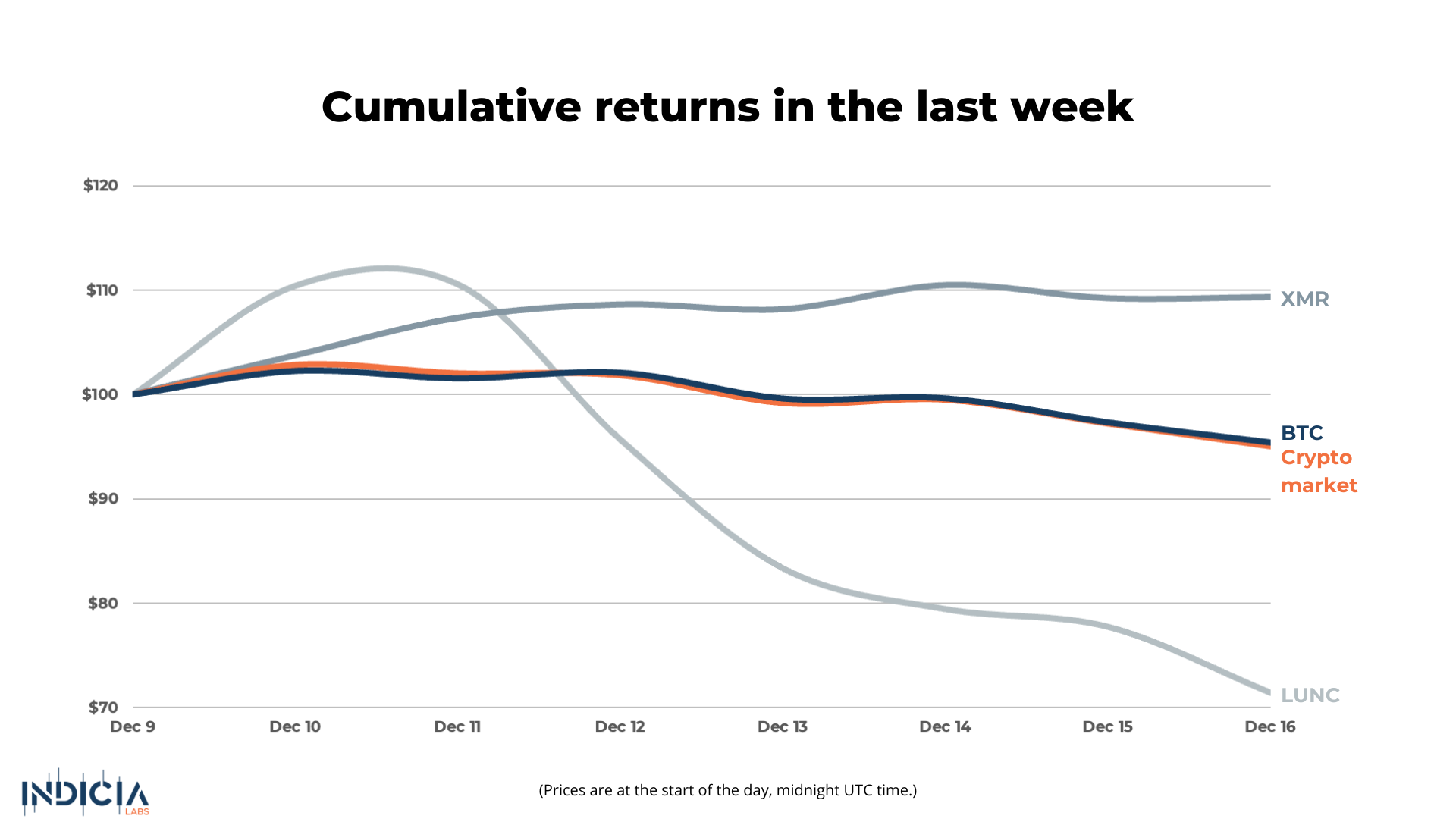
The crypto market declined 5.0% this week as risk appetite faded across digital assets. Bitcoin (BTC) fell 4.6%, giving back part of last week’s rebound. Monero (XMR) was the top performer, gaining 9.4%, while Terra Classic (LUNC) reversed sharply after last week’s outperformance, dropping 28.5%.
🧐 What is your crypto mood today?

In each Sophia's Thoughts newsletter, we ask about your crypto mood. Your response to this question helps Sophia get a better sense of the pulse of crypto markets. And this ultimately translates into better insights for you when combined with Sophia's AI models. Your data empowers Sophia to provide you with even better intelligence going forward!
💹 The Fed Chair Race Is Already a Market Variable
Historically, the Federal Reserve Chair appointment becomes relevant to markets only after a nominee is announced. This cycle is different. Markets are already reacting to the process itself.
Recent reporting indicates President Trump is focused on two leading candidates to succeed Jerome Powell when his term ends in May 2026. As the Wall Street Journal reports, “Trump is eyeing two candidates in particular—Kevin Hassett and Kevin Warsh—for the job.”
While earlier signals suggested an announcement could come before Christmas, the White House has since indicated the decision will likely be made in early 2026: “Bessent in particular has lobbied to announce the Fed nomination sooner rather than later… [but] the president has indicated the decision will instead be made in early 2026.”
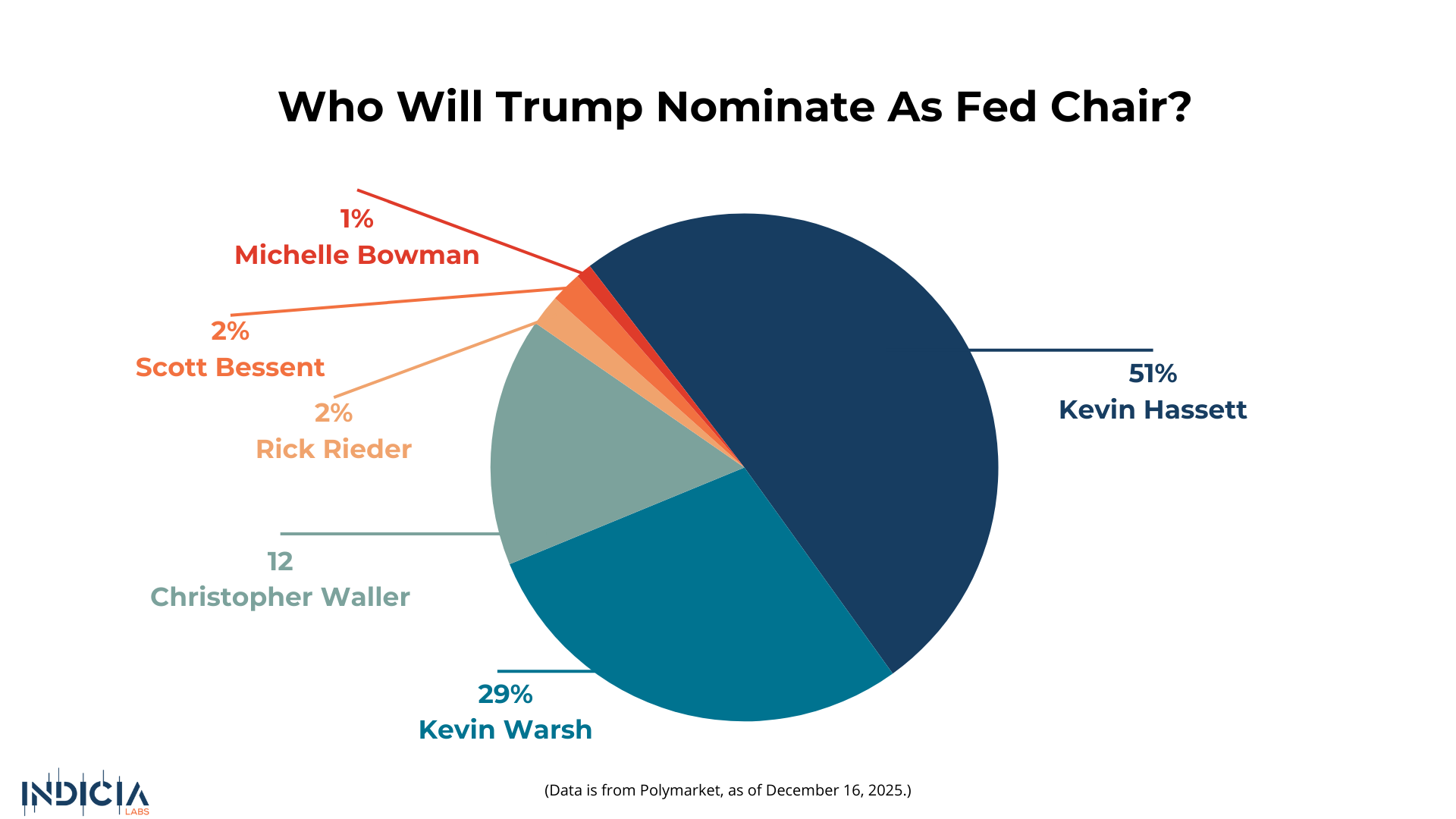
Despite the absence of a formal decision, markets have begun pricing the implications. Prediction markets reflect a competitive race, with Kevin Hassett currently leading at roughly 51%, followed by Kevin Warsh at approximately 29%, while other candidates remain long shots.
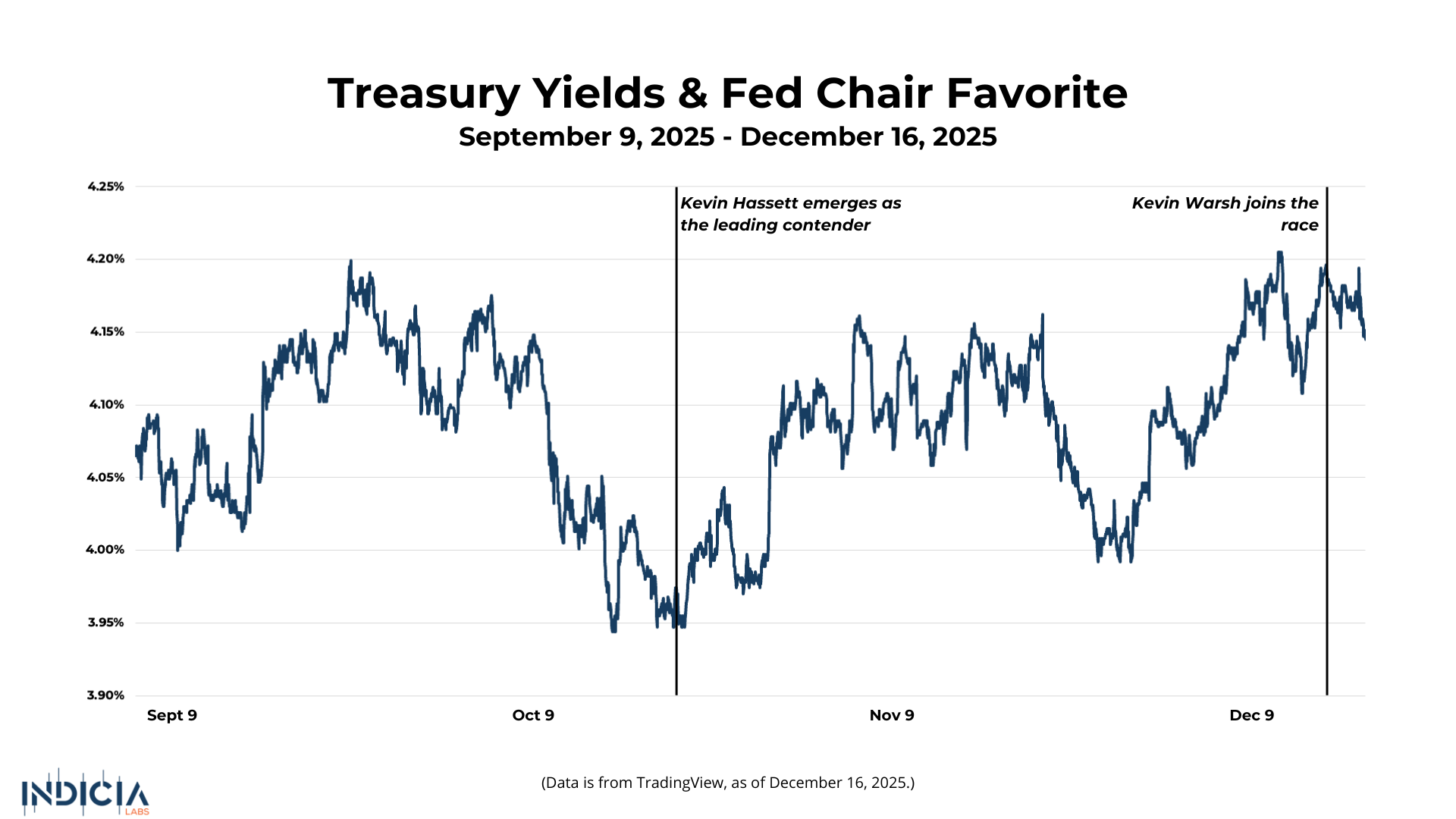
Bond markets have responded accordingly. Treasury yields moved higher as Hassett emerged as the perceived frontrunner, before easing as Warsh gained momentum, a dynamic highlighted by Milk Road Macro using TradingView data. The reaction suggests investors are not reacting to expected rate cuts, but to the perceived credibility of future monetary leadership.
The implication for crypto is indirect but important: digital asset markets are sensitive not just to policy outcomes, but to institutional confidence in the global monetary system.
💸 Independence, Credibility, and the Cost of Capital
At its core, the Fed Chair race has become a referendum on central bank independence. That distinction matters because independence influences long-term inflation expectations and term premia.
Concerns around Kevin Hassett stem less from his policy stance and more from his proximity to the White House. As Yahoo Finance notes, “Hassett’s allegiance to the White House raises questions for investors, who generally prefer central banks that are firmly independent of politics.”
Hassett has acknowledged his close relationship with President Trump, stating on Face the Nation: “I’d be happy to talk to the president every day … until both of us are dead because it’s so much fun to talk.”
Kevin Warsh, by contrast, has positioned himself as more institutionally focused, despite holding dovish views in certain frameworks. In a recent Wall Street Journal op-ed, Warsh argued that “inflation is a choice,” and criticized the Federal Reserve’s recent history under Chairman Powell as one of “unwise choices.” He also warned that “the Fed is an institution whose reach has extended far beyond its grasp.”
For markets, this distinction matters. Bond investors are not simply pricing the path of short-term rates; they are pricing whether the Federal Reserve can credibly commit to its mandate without political interference. When that credibility is questioned, longer-term yields can rise even amid expectations of easier policy.
Crypto markets sit downstream of this dynamic. As CoinDesk has observed, “prices of speculative assets like crypto tend to perform better when monetary policy is being eased and tend to struggle when policy is being tightened.” However, crypto is increasingly responsive to a second channel: confidence in monetary institutions themselves. When institutional credibility weakens, bitcoin’s role as a hedge against monetary mismanagement becomes more salient.
👀 What to Watch as the Decision Approaches
As Jerome Powell remains Fed Chair until May 2026, an early nomination would introduce a period of dual influence. CoinDesk has noted that naming a successor well in advance would “create a shadow Fed chair for Powell to have to deal with in his term’s final months.”
This dynamic could complicate forward guidance and increase volatility across rates, currencies, and risk assets.
Key signals to monitor include:
Long-term Treasury yields: Rising yields amid dovish rhetoric would indicate growing term-premium concerns rather than optimism around growth.
The U.S. dollar: Dollar strength alongside higher yields typically reflects tighter financial conditions.
Rate-cut expectations versus asset performance: Divergence between easing expectations and asset prices often signals narrative-driven risk.
Prediction market volatility: Rapid shifts in nomination odds may reflect headline sensitivity rather than conviction.
Crypto’s relative performance: Strength during periods of rising yields would suggest a confidence-driven bid rather than a liquidity-driven rally.
The Fed Chair race has already become a macro catalyst, not because of policy changes, but because it introduces uncertainty around institutional credibility.
For crypto markets, the central risk is not the precise path of interest rates, but whether markets continue to trust the independence and coherence of the world’s most important central bank. That question is now being priced, well before any nomination is made.
Indicia Labs does not provide investment, tax, or legal advice. You are solely responsible for determining the suitability of any investment, investment strategy, or related transaction based on your personal investment objectives, financial circumstances, and risk tolerance. Indicia Labs may offer educational information about digital assets, which may include blog posts, articles, third-party content, news feeds, tutorials, and videos. This information does not constitute any form of advice, and you should not rely on it as such. Indicia Labs does not recommend buying, earning, selling, or holding any digital asset and will not be responsible for any decisions you make based on the provided information. Any content provided by Indicia Labs may contain errors, inaccuracies, or outdated information and should not be relied upon for making any investment decisions and Indicia Labs and its affiliates hold no responsibility for the accuracy of the provided information or content.
As with any asset, the value of digital assets can fluctuate, and there is a significant risk of losing money when buying, selling, holding, or investing in digital assets. Consult your financial advisor, legal or tax professional regarding your specific situation and financial condition, and carefully consider whether trading or holding digital assets is suitable for you.
Indicia Labs is not registered with the U.S. Securities and Exchange Commission and does not offer securities services in the United States or to U.S. persons. You acknowledge that digital assets are not subject to protections or insurance provided by the Federal Deposit Insurance Corporation or the Securities Investor Protection Corporation.